Thursday, February 13, 2014

Four Things You Can Do To Protect Your Home From Pest Birds

 photo f8d20e0c-6494-4389-880e-e3b9162a8f41_zps6c3039b1jpg


If you’re like most homeowners, you want to keep the outside of your home looking fresh and clean. But pest birds can change all that. Their droppings and nesting debris can quickly deface and often damage your home. Areas most vulnerable include siding, windowsills, patio cover, decorative weather vanes, solar panels, skylights, awnings and fencing.  Birds that typically cause problems include pigeons, sparrows, starlings, swallows and gulls. To keep bird pests at bay, the bird control experts at Bird-B-Gone have four suggestions that can help.

1.    Remove Attractions. Get rid of standing water, keep trashcan lids secure, clean up any leftover food after parties or get-togethers, and trim plants and vegetation.

2.    Install Bird Spikes. Bird-B-Gone Stainless Steel Bird Spikes won’t allow pest birds to land on or near them. These humane, highly effective bird deterrents feature rows of stainless steel spikes embedded in a UV-protected polycarbonate base. This makes them highly durable and ideal for outdoor use. Bird spikes are used worldwide to keep bird pests off ledges, rooflines, eaves, windowsills, awnings and canopies. The spiked strips come in two-foot sections and three different widths—3-, 5- and 8-inch—to match the width of the “problem” area. The base of each spiked strip is just 1.5 inches wide, so it’s easily installed on narrow surfaces using screws, tie downs or glue.

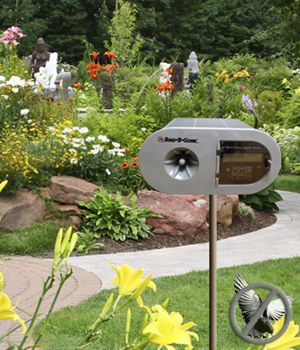
3.    Install a Sonic Bird Deterrent. Bird-B-Gone’s Solar Bird Chase Super Sonic broadcasts distress and predator calls that intimidate birds. You can set it to scare any of 22 specific bird types or choose the general setting to intimidate virtually all birds. Scientifically developed with the help of ornithologists, Solar Bird Chase Super Sonic repeats these calls every 10 minutes to convince birds that dangerous predators are near. Unlike ultrasonic devices that emit high-frequency sounds birds can’t hear, the Bird Chase system is fully audible to birds, yet it won’t annoy pets or neighbors. The device comes with a built-in speaker that will cover up to an acre.

4.    Create Visual Distraction Zones. Bird-B-Gone Visual Bird Deterrents will scare birds away. The most basic is Flash Tape, a 50-foot roll of iridescent foil tape that you cut into short strips. Hung in high visibility areas, the strips crackle in the breeze and reflect sunlight to scare birds away. No less effective is the Scare Eye Diverter, a tear-drop-shaped iridescent foil deterrent emblazoned with a large “predator” eye. The same holds true for the Bird Scare Balloon, a large inflatable “beach ball” that also has a big predator eye. When the Diverter and Balloon bob and weave in the wind, birds regard them as predators. For best results, Bird-B-Gone suggests that visual bird deterrents be moved around so that birds don’t get used to them.



Thursday, August 22, 2013

Too Many Birds in Your Backyard?

Everyone enjoys the sound of a bird or two. And you may even have a birdbath and bird feeder in your backyard to attract them. But there comes a time when you just have one bird too many. Especially if your backyard is attracting crows or pigeons. They can make an awful racket and leave a huge mess on everything from patio furniture to BBQs.

If you have a pool or spa in your backyard, you’ll have a major cleaning chore if birds poop in the water—doing everything from emptying the pool to re-balancing pH levels. You just can’t leave bird droppings to gather anywhere, especially if you have kids or pets that touch and lick everything. Bird droppings can carry any of 60 known diseases—like salmonella.

If you’ve tried hanging metallic strips and old CDs or DVDs around your patio cover and trees, or placing inflatable owls on your patio table or serving bar--and the birds simply ignore them--you need to consider investing in some serious, professional bird control. Here’s one bird deterrent the pros recommend:

Solar Bird Chase Super Sonic

Scientifically designed to keep birds from landing, roosting and nesting in your backyard, the Solar Bird Chase Super Sonic fully exploits a bird's acute sense of hearing and natural fear of predators. Birds can recognize and remember sounds in absolute pitch. Birds can also hear shorter notes than humans. We process sounds in bytes about 1/20th of a second; birds only need 1/200th of a second. Some birds, like pigeons, hear much lower sounds than we do. One thing birds share with humans is their range of hearing, which is most sensitive between 2,000 Hz and 4,000 Hz.

Highly effective against many bird species

The Solar Bird Chase Super Sonic uses this knowledge of birds to create a highly effective sonic bird deterrent. In fact, the device can broadcast distress and predator calls that birds find particularly alarming. It recreates the sound of Peregrine falcons (a pigeon's dreaded enemy) defending their territory. Or the sounds of predator hawks screeching and gulls under attack. These sounds are repeated regularly--about once every 10 minutes. The Bird Chase system is also highly versatile, emitting distress and predator calls for as many as 22 types of birds. So you can set the system to emit distress and predator calls to deter starlings, seagulls, pigeons, crows, swallows, woodpeckers, sparrows, grackles, cormorants and many others.

Won’t annoy pets or your neighbors

The other good thing about the Solar Bird Chase Super Sonic is that it’s highly effective without annoying pets or humans. That’s because the sounds it emits simply resemble normal bird sounds.

Easy to set up

The Bird Chase Super Sonic is designed for outdoor use. It can be mounted on your patio cover or under an eave. Set in the sun for at least 8 hours to charge the batteries, set it for a specific bird, or to the general setting, and the device will protect a full acre of backyard day and night.

Thursday, August 8, 2013

Birds Eating Your Garden Bare? Time for Bird Control!

You sweated, toiled and tilled your garden until your hands were as blue as the blueberries you’re growing. But all that hard work could be in vain if you don’t protect your garden against pest birds. They’ve been eyeing your ripening fruits and veggies for weeks now, just waiting for you to go inside so they can feast on your bumper crop of goodies.

Sparrows, swallows, pigeons and crows are just some of the pest birds you’ll need to worry about. As are blackbirds, starlings and robins. And little did you know that if you regularly spray pesticides to limit the amount of insects in your home garden, birds will simply eat more of your fruits and vegetables. It’s a no-win scenario unless you implement some effective bird control measures. One of the best bird deterrents you can get to protect your garden is Garden Bird Netting. 

Garden Bird Netting

Used by professional growers and gardeners, Garden Bird Netting physically blocks birds from specific areas of your garden, yet allows sun, rain and fresh air to nurture your fruits and veggies. Spread over your plants, the netting denies birds access to fruit trees, berry bushes, vegetables and other edible garden plants. And it does so humanely without bird poisons or traps. Although it’s designed for temporary use, Garden Bird Netting is made of tough, UV-protected polypropylene. It comes in a 3/4-inch mesh size to seal off today’s most troublesome birds. Other mesh sizes include a ½-inch and ¼-inch to block out smaller birds. You can buy this netting in pieces or bulk rolls of 14 x 100 feet and 14 x 200 feet. The large rolls can easily be cut down to the desired size.

Easy to Use

Garden Bird Netting is light, easy to handle and virtually invisible to the eye. Simply follow these guidelines to ensure your plants are properly protected against the ravages of pest birds:

For Blueberry Bushes and Grape Vines. Suspend the Garden Bird Netting over your bushes or vines, leaving at least a four-inch space between the netting and the bush or vine. This will prevent birds from sitting on the net and eating fruit through the mesh using their necks and beaks. You can also suspend the netting from a series of poles placed around the perimeter of your garden or plants.

For Vegetable Gardens. Wrap each of your individual plants in netting. You can also suspend the netting around an entire garden area to completely block out pest birds. To secure the netting and ensure that it stays taut, use zip ties, twine or similar materials.

Fruit Trees. Measure the circumference of the tree and cut the net accordingly. Make sure you cut at least one foot extra. The netting can be secured with twine, zip ties, or hog rings. Garden bird netting clips are also available to simplify installation.

For additional advice on how to deter pest birds from your garden, consult an expert like the folks at Bird-B-Gone.

Wednesday, July 17, 2013

A Very Sound Bird Control Strategy for Your Home

patio bird control
While the sounds of birds chirping by your window may be pleasant, the damage birds leave behind may not be. Birds can ruin the appearance of your front porch, back patio, gazebo, pool or spa. They can peck and nest under your roofing tiles causing leaks. Bird droppings eat into paint, wrought iron, patio furniture, cushions and BBQs.

Cleaning bird droppings can get very messy. Everything you wash them off with should be disinfected or thrown away. If you try to simply brush droppings off when they’re dry, you'll aerate the germ-filled dust, which can carry some very nasty diseases—like salmonella.

So how do you keep birds away this summer—without harming them? One very effective and humane solution uses a sound approach. It’s called the Bird Chase Super Sonic.

The Science of Sonic Bird Deterrents

Scientifically designed to keep birds from landing, roosting and nesting on your property, the Bird Chase Super Sonic fully exploits a bird's heightened sense of hearing and its natural fear of predators. Birds can recognize and remember sounds in absolute pitch (the ability to reproduce a tone without reference to an external standard). Birds can also recognize 'timbre' (a fundamental note combined with harmonies). And birds hear shorter notes than humans. We process sounds in bytes about 1/20th of a second; birds just need 1/200th of a second. So in the time it takes humans to hear one sound, birds hear up to ten separate notes. Some birds, like pigeons, hear much lower sounds than humans. One thing birds have in common with us is range of hearing, which is most acute between 2,000 Hz and 4,000 Hz.

Using Distress and Predator Calls to Deter Birds

The Bird Chase Super Sonic can broadcast the distress and predator calls for 22 different species of birds. This includes the sounds of Peregrine falcons (a pigeon's dreaded enemy) defending their territory. Or the sounds of predator hawks screeching and gulls under attack, sounds that strike fear in the hearts of starlings and seagulls. Which means the Bird Chase sound bird deterrent can be set to deter virtually any bird that has become a problem on your property--pigeons, crows, starlings, swallows, gulls, woodpeckers, sparrows, grackles, cormorants and many others. And since it continually alters the pitch, frequency, timing and intensity of these sounds, the "threat" is kept fresh and alive to deter birds that may quickly get used to repetitive sounds. The distress and predator calls are repeated regularly--about once every fifteen minutes.

Non-Annoying to Humans and Pets

Another key advantage of the Bird Chase device is that the sounds it emits resemble normal bird calls to humans. And pets aren’t bothered by them. What’s more, unlike ultrasonic bird deterrents that emit sounds birds can’t hear and do annoy pets, the Bird Chase unit is fully audible to all birds and thus very effective.


Tuesday, May 14, 2013

The Cicadas Are Coming? Are You Ready to Block Them?

 photo cicadabugs_zpsd4b7a5d3jpg
Millions of cicada bugs are expected to “explode” from the soil this spring. They’ve been patiently waiting for 17 years.  And when they emerge, they’ll head straight for your favorite plants and fruit trees.

The devastating insects are among 15 “broods” of periodical cicadas that show up every 17 years or so. When they work they way out of the ground—after sucking the fluids from your tree roots—they’ll cut slits into your tree’s branches to lay their eggs. The bugs are pretty easy to spot. They have orange legs, red eyes and clear wings. Expect them to pop out at night when the ground temperature rises to 64 degrees. If you’re not ready for them—1/4-inch mesh bird netting blocks cicadas nicely—you can say good-bye to your young saplings and plants. Cicadas are particularly fond of trees that have branches that are 1/4- to ½-inch in diameter. These are preferred by egg-laying cicada females.

Few trees and plants are safe from cicadas

Think your trees and plants are safe. Think again. Cicadas will swarm over a wide range of trees, including maple, oak, hickory, beech, ash, dogwood, hawthorn, magnolia, willow, apple, peach, cherry and pear. Cicadas will also attack your favorite flowers, vines and shrubs. Rose of Sharon, rose, raspberry, grape, black-eyed Susan, hollies, spirea, rhododendron, viburnum, junipers, and arborvitae—all are vulnerable to attack by these noisy little bugs. In fact, they can pretty much wipe out an entire garden or grove in just a matter of days.  All the more reason to be pro-active with an effective cicada deterrent.

Block them out with Bird-B-Gone 1/4" plastic netting

What you need to protect your trees and plants is a barrier deterrent that has been proven effective in gardens, yards and orchards nationwide. A bug deterrent that doesn’t depend on spraying toxic chemicals on your plants and trees, chemicals that maybe harmful to your pets and children. It’s called 1/4" Plastic Netting. Easy to handle and install, Bird-B-Gone 1/4" Garden Netting protects your prized plants and saplings by denying access to them. The netting comes in 14 x 100-foot and 14 x 200-foot rolls and can be easily cut to the size you need to cover your small trees, plants or shrubs. Netting clips are available to ensure the netting remains in place during windy or rainy periods. Manufactured from a durable, UV-protected polypropylene, this high quality netting is made to last in harsh outdoor climes. For best protective results, wrap the netting over your saplings, plants and trees when the cicadas fist begin to buzz. Tie the netting to the stem or trunk under the lower branches to protect them. Once the cicadas leave (stop buzzing), you can usually take the netting down. Or you can keep the netting in place to protect your plants and ripening fruit from pest birds.

For additional advice on how to keep cicadas away from your plants and trees, consult an expert like the folks at Absolute Bird Control.

Tuesday, January 8, 2013

Bird Netting for Effective Garden Bird Control

Garden Netting, Get rid of birds with garden bird netting.

Your garden will be flourishing soon. All those fruits and vegetables that you’ve been nurturing for months will finally be bearing the benefits of your hard work. Unless, of course, you failed to implement an effective bird control strategy. In that event, your efforts may prove to be in vain. For surely as the sun rises, birds will feed off your ripening fruits and veggies this spring.

Adding insult to injury, pest birds will also cover your garden with droppings, which are not only unsightly but can carry any of 60 infectious diseases. Instead of a garden richly scented with ripening fruit, you’ll have a smelly garden covered with bird droppings.

What to do? Most people who nurture gardens are reluctant to use lethal means to get rid of birds. Many will use water hoses to “shoo” them away. Others will rattle pots, pans and noise makers. But these measures have proven largely ineffective in the long run. Birds simply return minutes after you go indoors. The only real solution is to implement professionally recommended bird control measures. Among the most effective for gardens is Garden Bird Netting.

Lightweight and easy to handle, Garden Bird Netting will deny birds access to your fruits and vegetables. Ideal for fruit trees as well as garden plants, this netting will protect your blueberry bushes, grape vines and other plants from being attacked.  It's sold in 14 x 100-foot and 14 x 200-foot rolls, and you can easily cut it down to the size to need to protect specific plants or areas.  It’s also available in three different "mesh" sizes--1/4" mesh, 1/2" mesh and 3/4" mesh to protect your garden from a wide variety of pest birds. The netting is easy to install, and bird netting clips are available that make for effortless installation. The best Garden Bird Netting is made from a durable, UV-protected polypropylene. This netting is strong, light and virtually invisible.

Garden Bird Netting is also highly recommended to prevent birds from nesting. Birds who are in the process of nesting can be very territorial. They will return to previously established nesting sites and protect them. Bird netting places your garden off limits so birds simply move on. You can install Garden Bird Netting temporarily if you have seasonal problem with birds, or you can install the netting permanently for year round protection.

Working effectively with Garden Bird Netting to achieve bird control are Visual Bird Deterrents. These include reflective foil and banner tape strung up on nearby trees, posts or fencing. By rattling in the breeze and reflecting sunlight, they create a distraction zone around your garden. Tear-drop shaped Bird Scare Diverters and Bird Scare Balloons accomplish the same result with their large, intimidating predator eyes bobbing in the wind. Visual distractors like these need simply to be moved around every so often to convince birds that they are an on-going threat.

Tuesday, November 6, 2012

Why Birds Are Attacking Your Garden and What to Do About It

get rid of pest birds, get rid of pest birds with bird control products

If birds are continually attacking your garden and you’re at wits end, there are some very specific reasons why they’ve chosen your garden over others in the neighborhood.

First off, you may have ripening fruit that birds love to eat. Tomatoes, grapes, peaches, apples, pears, and the like are all invitations to any bird looking for an easy meal.

If you have lots of leafy trees in your backyard, birds can perch on them without being seen, and dive in for a meal the minute you leave your garden.

If you have a birdbath, that will attract birds. And once they see your ripening fruit, they’ll feast on it.

If you don’t have a dog or cat, birds will shy away from any neighbors who do and consider your garden a safe haven.

If you don’t have lots of children constantly playing in your garden, once again, birds will not free threatened and visit your garden.

If you do have children and they continually leave crumbs and food scraps on your patio table and underneath it, birds will dive in for the smorgasbord.

If you’ve tried poisons to get rid of the birds, they’ll still come, since you haven’t removed the other attractions of your garden, e.g., ripening fruit. You could try leaving the dead bird to rot in your garden. This may deter some birds, but the sight and smell of a dead bird ripening in the sun is a pretty stiff price to pay. Besides, your family and neighbors will start calling you “Cruella” if you go this route.

If you’ve tried trapping birds and they still invade your garden, again, you haven’t removed the initial attraction—the food source—so your garden still presents an inviting place to feast.

So what can you do to keep birds out of your garden? Some suggestions from the pros:

Garden Bird Netting

Lightweight, strong and practically invisible,  Garden Bird Netting can be draped over your small fruit trees and vegetable plants to deny birds access to your prized crops. The netting comes in 14 x 100-foot and 14 x 200-foot rolls and is easily trimmed to the desired size. It’s also sold in three different "mesh" sizes:1/4" mesh, 1/2" mesh and 3/4" mesh. Be sure to get the bird netting clips for hassle-free installation. The best netting is made from a durable, UV-protected polypropylene.

Sonic Bird Deterrents

Ideal for large gardens, Sonic Bird Deterrents broadcast bird distress and predator calls that create fear and panic in any approaching bird. The pre-recorded sounds resemble normal birdcalls, so they won’t irritate your pets, friends or neighbors. If your garden is being attacked by several varieties of birds, there’s one sonic system you can get that emits distress and predator calls for 22 different species of birds.

Visual Bird Deterrents

Used with other bird deterrents, Visual Bird Deterrents--which you can easily hang just about anywhere--include Flash Tape and Reflective Banners. These flagellate in the breeze and catch the sunlight to distract birds. You can also hang Scare Eye Diverters and Bird Scare Balloons from your trees and patio covers. These will twist and bounce in the wind and display their large predator eyes to intimidate birds.

Thursday, October 4, 2012

Bird Control to Keep Pest Birds Away from Lawns & Gardens

bird deterrents for gardens, keep your gardens bird free with bird control products

by Alex A. Kecskes

It’s that time again. Time for spring and summer garden parties. Time to invite all your friends and relatives over for those great outdoor barbeques.  Only problem is, you’ve got pest birds circling around your backyard. Last year, they pooped all over your lawn and garden. You know they’ll be back this year, just waiting for you to place your smorgasbord of snacks and edible goodies on your patio table to feast on.

But you’re a bird savvy homeowner now. You know about bird control. And this year you’re going to fight back. Not with poisons, or pellet guns or the garden hose.  No, this is the year you win the battle of pest birds. You’ve consulted with the pros—bird control experts who know how to deter pest birds, effectively and humanely.  This year, you’re going to arm yourself with the tools professional use.

Scarecrow Bird Deterrent

Pest birds don’t have a prayer of sneaking by this bad boy. Scarecrows are motion activated and any birds entering their zone of protection get a sobering blast of water to remind them this is not the yard they want to call home.  The device features a realistic looking bird-like moving head and connects in a jiffy to almost any garden hose. It covers a 1,200 square foot area that extends 35 feet out by 45 feet wide. You can even adjust a Scarecrow’s sensitivity and range to cover specific areas of your backyard.

Visual Bird Deterrents

This is a pretty inexpensive, but effective bird control strategy. Here, you’re relying on the visual intimidation factor of Flash Tape and Reflective Banners, which reflect sunlight and snap in the breeze. Also in this category are Scare Eye Diverters, large teardrop shaped plastic panels covered with big  “mock” predator eyes. Equally effective are Bird Scare Balloons, which are covered with large predator eyes. Visual bird deterrents are easy to attach to patio covers, gazebos, tree branches, or any elevated area in your backyard. The balloons can be filled partially with water to skim the surface of your pool or spa. Keep in mind that visual bird deterrents should be moved around frequently or birds will get wise to your tactic.

Sonic Bird Deterrents

Many golf courses and industrial parks use these to keep pest birds away from their lawns and gardens. If you have a big back yard, Sonic Bird Deterrents will do the trick. The scientifically designed devices broadcast bird distress and predator calls that resemble normal bird sounds to humans. They won’t irritate pets or your friends and neighbors. One sound bird deterrent system is really handy, for it has the ability to emit distress and predator calls for 22 different species of birds. This unit covers up to an acre of land and can be programmed to turn on or off at night.


Tuesday, August 14, 2012

Getting Rid of Pest Birds in Gardens

bird deterrents for gardens, keep your gardens bird free with bird control products

by Alex A. Kecskes

A beautiful garden can be a joy to behold. It reflects the hours of work and care you put into it—the feeding and weeding and spraying for bugs. But unless you exercise some form of effective bird control, your well-tended garden can quickly be ruined by pest birds. Vegetable and fruit gardens are particularly vulnerable. While a few songbirds can add a certain ambiance to a garden, gathering flocks of birds—like crows, pigeons, finches—can destroy ripening fruit and vegetables. They can leave droppings everywhere, turning your garden into a smelly, disease-carrying mess.

The only way to protect your garden is with proven effective bird deterrents. And the best way to ensure your garden won’t be attacked by flocks of pest birds is to implement these bird deterrents before your fruits and vegetables ripen.

Here are three of today’s most popular and effective pest bird deterrents:

Plastic Bird Netting

Creating a physical barrier that denies birds access to specific areas of your garden, Plastic Bird Netting offers a humane, low profile bird deterrent. The netting usually comes in 14 x 100-foot and 14 x 200-foot rolls and three different mesh sizes. There’s a 1/4-inch mesh for smaller birds and a 1/2-inch mesh and a 3/4-inch mesh for larger birds. The best plastic bird netting is fabricated from durable, U.V.-protected polypropylene. This netting is strong, light, easy to handle and virtually invisible.

Install bird netting before your garden bears fruit or vegetables. Suspend the netting over your bushes or vines by at least 6 inches. Protect vegetables by wrapping individual plants in netting or suspend the netting around an entire garden area. To safeguard fruit trees, measure the circumference of the tree and cut the net to size (allow at least one foot extra around the circumference). Secure the netting with twine, zip ties, or hog rings.

Sonic Bird Deterrents

These devices broadcast bird distress and predator calls that make birds feel too uneasy to stay in your garden. The sounds resemble normal bird sounds, so they won’t irritate your pets, friends or neighbors. One highly versatile sonic system can emit distress and predator calls for 22 different species of birds. This unit covers up to an acre of land and can be programmed to turn on or off at night.

Visual Bird Deterrents

Ideally, you would want to use Visual Bird Deterrents in conjunction with the two deterrents mentioned above. These consist of Flash Tape and Reflective Banners, which reflect sunlight and snap in the breeze to make birds too nervous to feed. Also included in this category are Scare Eye Diverters and Bird Scare Balloons—both feature large predator eyes to intimidate pest birds. Visual bird deterrents attach easily to patio covers, gazebos, tree branches, or any elevated area in your garden. Just remember to move them around frequently to convince birds they are “live” threats.


Monday, August 13, 2012

3 Ways to Protect Your Home Garden from Pest Birds

Photobucket

by Alex A. Kecskes

As a homeowner, you know that pest birds can cause considerable damage to your garden. Fruits are especially vulnerable and can be quickly ruined by even a few birds.

Today, 95 percent of all American gardens grow tomatoes. One woman in North Texas suffered extensive damage to her tomato plants by mockingbirds. As soon as her tomatoes got red, ripe and ready to pick, the birds would take bites out of them. They would continue to nibble on her tomatoes all day long. A great-looking tomato, almost ready to pick in the morning, would be ruined with bite marks by late afternoon. Effective pest bird deterrents would have saved her tomatoes.

A sure sign that birds are attacking your fruit is the presence of holes throughout. Starlings and blackbirds can eat the fruits and vegetables you worked so hard to grow. Canada geese will munch on your grass and leave nearly a pound a day (per goose) of droppings. Birds can also damage your favorite trees. They’ll rip through bark searching for bugs. Few plants are safe from pest birds. They’ll use their beaks to rip, tear and tug your plants pieces.

The temptation is to resort to lethal bird control measures—like BB guns and poisons (avicides). But if you have pets or children, these methods are highly undesirable as well as being inhumane to birds. Fortunately, there are a number of bird deterrents on the market that are both effective and humane. They’re ideal for keeping pest birds out of your garden. 

Here are three proven bird control measures:

Lightweight Plastic Bird Netting

Plastic bird netting lets you exclude pest birds from garden, enclosed courtyard, patio or similar area. The netting comes in various mesh sizes to block out pigeons, sparrows, starlings, seagulls and other birds. The best high quality bird netting is available in various colors to blend in with your garden’s décor. One manufacturer offers a bird netting kit for fast, easy installation. The kits include perimeter cable, cable crimps, turnbuckles, intermediate attachments, hog rings, and accessories and tools.

Sonic Deterrents

These devices generate distress and predator calls that make birds too scared to hang around and feed. One commercially available system can generate such calls for 22 different species of birds. The calls, repeated every 10 minutes, resemble natural birdcalls to humans and won’t irritate pets. You can set a volume control to generate from 65-105 decibels, and you can program the unit to turn on or off at night. The best bird sonic units come with a built-in speaker that protects gardens up to an acre.

Bird Scare Deterrents

These inexpensive bird deterrents create an “Optical Distraction Zone” that makes pest birds too nervous to hang around your garden. They consist of reflective foils, shiny tape banners and balloons that are easy to install. Some balloons have giant predator eyes to give birds that “spied on” feeling. Balloons can also be filled partially with water to skim the surface of swimming pools, spas and Koi ponds.


Friday, May 4, 2012

Bird Control to Keep Your Pool and Spa Free of Pest Birds

Photobucket


by Alex A. Kecskes

If you own a home with a pool or spa, it can be a great source of pride and an ideal amenity in the summertime. As a responsible homeowner, you no doubt take good care of your pool or spa. You clean it on a regular basis and add the required chemicals to keep it sanitary and safe.

Regrettably, a single bird dropping can render your pool or spa unsafe, for bird droppings can carry any of 60 known diseases. Bird droppings can also contaminate the railings and ledges of a pool or spa. Worse yet, slippery bird droppings on pool diving boards and ladder steps can cause divers to slip and fall, resulting in possible injury.

Fortunately, there are a number of effective bird deterrents you can use to keep pest birds away from your pool or spa. Here are two bird control measures you might consider:

Visual Bird Deterrents

Sometimes called Bird Scare Deterrents, these inexpensive bird distracters include Flash Tape and Reflective Banners, which reflect sunlight and snap in the breeze. You can also get Scare Eye Diverters, large teardrop shaped plastic panels emblazoned with a “mock” predator eye. Finally, there are Bird Scare Balloons, which are similar to diverters in that they are covered with large predator eyes to spook birds. These visual deterrents attach easily to patio covers or any elevated area near your pool or spa. Balloons can also be filled partially with water to skim the surface of your pool or spa. The only thing to remember about these visual bird deterrents is that you should move them around from time to time to keep pest birds on the alert.

Sound Bird Control

Often referred to as Sound Bird Deterrents, these devices emit bird distress and predator calls that resemble normal bird sounds one hears every day. They won’t irritate pets or your friends and neighbors. Birds, on the other hand will regard them as a threat and leave. One sonic bird control system currently on the market can emit distress and predator calls for 22 different species of birds. It has a built-in speaker and will be protect your pool or spa from pigeons, crows, starlings, swallows, gulls, woodpeckers, sparrows, grackles, cormorants and many other birds. The unit features a volume control and can be programmed to turn on or off at night.

Scarecrow Bird Deterrent

This motion activated device confronts any bird entering its radius of protection with a harmless water blast, startling sprinkler sound, and realistic looking bird-like moving head.

Scarecrows connect easily to most garden hoses and offer over 1,200 square feet of protection that extends 35 feet out by 45 feet wide. These devices are inexpensive to operate, providing up to 1,000 "firings" on a single 9-volt battery. You can even adjust their sensitivity and range to meet the specific needs of your pool or spa.

Wednesday, May 2, 2012

Bird Control Strategies for Homeowners with Blue Heron Blues

Blue Heron, Get rid of blue heron with bird control products.

by Alex A. Kecskes

If you own a home near the ocean, river, pond, or lake, you may have had a run in with blue herons. These tall, light blue-grey birds have long black legs, pointed beaks, black bellies, and a black stripe along their white heads.

While they may be beautiful to look at, they can present a nuisance to your property. If you have a Koi pond, for example, you and your Koi may not be too happy to see them.  For in addition to amphibians, invertebrates, reptiles, birds, and small mammals, blue herons enjoy feasting on fish.

If blue herons are giving you the blues, here are some humane and effective bird deterrents the pros use:

Bird Spiders

Like most birds, blue herons don’t like spindly things that can strike their legs as they attempt to land. Bird Spiders have long tentacles that whip erratically in the breeze to make birds too nervous to land on rooftops or fence lines. Bird spiders are easy to set up on just about any even surface. The devices come in 2-, 4-, 6- and 8-foot diameter arm lengths to create ever widening zones of deterrence. The best bird spiders come with a glue-on base, so you can easily attach them to most surfaces.

Plastic Bird Netting

An easy-to-handle and install bird deterrent, Plastic Bird Netting creates a physical barrier that will keep blue herons from specific areas of your home.  The netting is typically sold in two roll sizes: 14 x 100 feet and 14 x 200 feet. You’ll want a relatively large mesh to block out herons. You’ll also want to invest in high quality, durable, U.V.-protected polypropylene netting, which is strong, light and virtually invisible. Nowadays, bird netting even comes in various colors to blend in with your home.

Solar-Powered Bird Repellers

Equipped with motor-driven “arms” that spin around continuously at 30 RPM, Solar-Powered Bird Repellers make it really rough for herons to land anywhere near them. You can easily position these repellers wherever herons gather most often. The best bird repellers come with adjustable arms that protect up to a 5-foot diameter area. And while they are solar powered, the best devices will also run at night or on overcast days, since they can store the sun's energy for later use.

Scarecrow Bird Deterrents

A silent sentry that springs to life the second a blue heron enters its radius of protection, Scarecrows do a convincing job of keeping birds away from your home. The motion-activated devices greet herons with a harmless water blast, startling sprinkler sound, and realistic looking bird-like moving head.  Scarecrows connect easily to your average  garden hose and will protect a 1,200 square foot area that extends 35 feet out by 45 feet wide. The best scarecrows will deliver up to 1,000 "firings" on a single 9-volt battery, and you can adjust their sensitivity and range.

Monday, April 30, 2012

Is Your Garden Party for the Birds?

Photobucket


by Alex A. Kecskes

It’s time for the annual round of garden parties. But unless you’ve implemented effective bird control measures, your garden party may be for the birds.

Many homeowners who have spent time and money to beautify their gardens are sending out invitations. Like you, they’re preparing for garden parties and backyard get-togethers with friends and relatives. As is typical during these functions, food and beverages of all kinds will be available on veranadas, under umbrealls and patios, and gazebos decorated in the season’s flowers.

But without bird control, pest birds can wreak havoc at a garden party. They can “dive bomb” food set out on tables, even snatch food out of the hands of children. And heaven forbid, your “uninvited guests” leave droppings on tables, chairs, benches and unattended food!

Fortunately, you can avail yourself of the pest bird deterrents today’s professionals use. These measures are both highly effective and humane. Here are a few of the most popular:  
Sonic Bird Deterrents

Ideal for large gardens, Sonic Bird Deterrents emit bird distress and predator calls that make pest birds want to leave. For example, some devices can broadcast the sounds of peregrine falcons (a pigeon's natural enemy) as well as the sounds of other pigeons being attacked. No bird wants to be in an area where they might be hunted. The sounds resemble normal bird sounds, so they won’t irritate your pets, friends or neighbors. If your not sure which species of bird is attacking your garden, one sonic system currently on the market emits distress and predator calls for 22 different species of birds. This unit covers up to an acre of land and can be programmed to turn on or off at night.  By the way, don’ bother with ultrasonic bird deterrents, for birds can’t hear them and they are largely ineffective.

Visual Bird Deterrents

Easy to set up and use, Visual Bird Deterrents can be highy effective in deterring pest birds from gardens and patios, especially when combined with other bird deterrents. Visual deterrents include Flash Tape and Reflective Banners, as well as Scare Eye Diverters and Bird Scare Balloons (featuring large mock predator eyes). Visual deterrents bob and weave in the breeze to create distractions that make pest birds too nervous to hang around. Simply attach these deterrents to any high visibility area in your garden and move them about from time to time.

Red-Tail Hawk Decoys

Combining decoration with function, Red-Tail Hawk Decoys intimidate most bids because real Hawks hunt during the day when most birds are active. It’s important to get the most realistic looking decoy you can find. And make sure it’s made of heavy duty plastic to endure several seasons outdoors. Here, again, it’s a good idea to move the decoy around often to convince birds that your decoy is a real threat.

Friday, April 20, 2012

Choosing the Right Bird Deterrent for Your Garden

Photobucket

by Alex A. Kecskes

It’s springtime and you’re ready to reap the rewards of your hard work in the garden. You diligently planted, weeded, and nurtured your garden. You also kept the pests at bay with regular spraying of insecticides. But now there’s a new threat to your garden: pest birds. They’re starting to come in and destroy your flowers, eat your tomatoes, and peck at the fruits ripening in your fruit trees.

You tried squirting these annoying birds with your water hose. But they just came back the next morning. Even your dog was no help, for the birds simply waited till your dog was in the house to feast on the vegetables and fruits in your trees.
You’re at your wits end on this one. Fortunately, your neighbor told you how the professionals get rid of pest birds. They use things that are effective and humane. Here’s what you discovered:

Wrap Up Veggie Plants in Plastic Bird Netting

Easy to use and highly effective, Plastic Bird Netting keeps pest birds from getting at the vegetable plants in your garden. This barrier deterrent is ideal for smaller gardens and small fruit trees. Wrap your plants with the netting or simply cover entire sections of your garden with the netting using poles. To protect fruit trees, measure the circumference of the tree and cut the net to size (allow at least one foot extra around the circumference). Secure the netting with twine, zip ties, or hog rings. Look for high quality plastic bird netting made of durable, U.V.-protected polypropylene. It's strong, light, easy to handle and virtually invisible.

Set Up a Sonic Bird Deterrent

If you have a large garden, or a number of fruit trees spread out over, say, an acre, you’ll want to invest in a Sonic Bird Deterrent. These devices emit bird distress and predator calls that convince pest birds that their natural enemy is hunting them in the area. The sounds resemble normal bird sounds, so they won’t irritate your pets, friends or neighbors. If more than one species of bird is attacking your garden, there’s one sonic system that emits distress and predator calls for 22 different species of birds. This unit covers up to an acre of land and can be programmed to turn on or off at night.

Hang Up Some Visual Bird Deterrents

An economical way to go, Visual Bird Deterrents can be most effective in deterring pest birds from your garden, especially when used together with other bird deterrents. They include Flash Tape and Reflective Banners, which reflect sunlight and rattle in the breeze. There’s also Scare Eye Diverters and Bird Scare Balloons. These bob and weave in the breeze and have huge large predator eyes to frighten birds away. You can attach a number of these deterrents in high visibility areas throughout your garden to spook pest birds.

Wednesday, April 18, 2012

Is Your Garden Overrun by Crows?

crow bird deterrents, get rid of birds with bird control products

by Alex A. Kecskes

If you’ve been invaded by crows, you know the damage they can do to your garden.  When they’re looking for worms or nightcrawlers, they can dig dozens of holes in your lawn in just a few minutes. Crows can also damage your prized flowers. And they can be extremely noisy, even in small flocks.

New research has shown that crows are among the most intelligent animals on the planet.  They can recognize individual human faces and pick them out of a crowd. They will also work together to defend their territories and use “spotters” as lookouts to warn the flock of impending danger. Without effective bird control, they’ll quickly ruin your garden.

If your thinking of shooting or poisoning them, crows are protected by federal law. While they can be hunted in certain states during specific times of the year, it’s best to check with your local fish and game department before attempting to shoot crows, or you could be in violation of the law. Of course, unless you live in the wide open country, with no kids or pets around, these draconian measures are too dangerous and impractical.

The best way to keep crows out of your garden is to use the bird control devices today's professionals use. Here are three suggestions:

Sonic Bird Deterrents

If you have a large garden, Sonic Bird Deterrents will deter crows from a wide area. They work on a bird’s psyche by emitting pre-recorded distress and predator calls. Crows will react to these sounds and avoid your garden. If your garden is also being attacked by other birds, you might want to invest in the system that emits distress and predator calls for 22 different species of birds. This system will cover an entire acre and you can program it to turn on or off at night.

Bird Spiders

Ideal for protecting specific areas of your garden, Bird Spiders have long spindly legs that whip about threateningly in the breeze to discourage crows from landing. Place one or two on a pedestal in your garden, and crows will avoid landing anywhere near them. Bird spiders come in several arm lengths to offer wider and wider areas of protection.

Scarecrows 

Using a motion-activated sensor to detect any bird’s approach, Scarecrows deliver a harmless but quite convincing blast of water to keep crows out of your garden. The devices connect easily to any standard garden hose and will protect a 1,200 square feet area (or a 35-foot by 45-foot wide swath). You can also adjust the sensitivity and blast radius to you specific needs.

Scare Balloons

These balloons are covered with a large eye, and will bob and weave in the breeze to appear lifelike and intimidate crows. The balloons can be attached just about anywhere, but should be moved around often—remember, crows are extremely intelligent.

Friday, April 13, 2012

Keeping Pest Birds Out of Your Garden

Get rid of Birds with Bird Netting, Get rid of birds with bird netting.


by Alex A. Kecskes

If you’re growing fruits, nuts or vegetables, you know the kind of care it takes to produce something edible and pesticide free. But now that spring is here, there are things you must do to protect your garden from invading pests. One of the biggest threats today’s gardens face is pest birds. Without effective bird control measures, your garden will have to survive attacks by the following pest birds this spring:

The House Sparrow, an abundant song bird, is a destructive forager destroying crops and gardens as they feed on seeds, fruits, and nuts. Redwings and fieldfares are nomads that will attack your berries. Flocks of invading mistle thrushes will devour your berry-clad bushes in minutes. The siskin, a small green and yellow member of the finch family, which will quickly eat all your seed producing plants.

Another bird to watch out for is the bullfinch, which can rapidly chew away 45 buds off a fruit tree in a single minute, stripping off an entire branch before you spot them and shoo them away. Starlings, common grackles and robins can destroy your blueberries. Cherries fall victim to starlings, robins, orioles and common grackles.

The best way to keep pest birds out of your garden is to implement the following, proven effective pest bird deterrents:

Garden Bird Netting

Opt for high quality netting. The best plastic netting for gardens is fabricated from durable, U.V.-protected polypropylene. It’s strong, light, easy to handle and practically invisible. You can either wrap your individual plants in netting or suspend the netting around an entire garden area. For fruit trees, measure the circumference of the tree and cut the net to size (allow at least one foot extra around the circumference). Secure the netting with twine, zip ties, or hog rings.

Sonic Bird Deterrents

These can be extremely effective and they’re preferred by many gardeners and growers because they cover a wide area without a lot of installation labor. Sonic Bird Deterrents emit pre-recorded bird distress and predator calls, which make pest birds feel too threatened to stay in your garden. Consider getting a versatile sonic system that can emit more than one sound—one system currently on the market can emit distress and predator calls for as many as 22 different species of birds. This system will cover an entire acre and you can program it to turn on or off at night.

Visual Bird Deterrents

Birds get real edgy and anxious to leave if they see what they think is a large predator watching them. That’s the theory behind Visual Bird Deterrents. The best of these are Scare Eye Diverters and Bird Scare Balloons, which are covered with large predator eyes. You hang them from a tree branch, patio cover or trellis and they bob and weave in the breeze to give pest birds the creeps.


Monday, April 9, 2012

How to Protect Your Home Garden from Pest Birds


by Alex A. Kecskes

It’s that time agin. Time to check how all your new fruits and vegetables are almost ready for the picking and eating. Ready, that is, if you protected your garden from pest birds using an effective bird control strategy. If you didn’t, you may find much of your garden has already been (or will soon be) feasted upon. By pest birds. Theywon’t hesitate to nibble and chew your fruits and veggies until there’s nothing left for you to enjoy.

Various species of birds will prefer to attack different parts of your garden. For example, crows and blue jays will go right for your corn.  Grackles and starlings will pull out and bite off your newly planted tomatoes. Mocking birds love to peck holes in your large beefsteak tomatoes—they usually prefer the one-pound, very green ones.

In general, many birds love to eat seeds and seedlings, as well as your fruits, berries and nuts. Other problem birds include gulls, magpies, pigeons, robins, sparrows and starlings. Geese and ducks can also wreak havoc with your garden. Besides trampling all over your garden, these larger birds can create quite a smelly mess in droppings. These droppings can carry diseases, which is not something you want all over your edible veggies.

The best way to keep pest birds out of your garden is to implement some proven effective bird deterrents.  Here are three the experts recommend:

Sonic Bird Deterrents

Easy to set up and use, Sonic Bird Deterrents emit bird distress and predator calls, which make birds think twice about invading your garden. One sonic system can emit distress and predator calls for as many as 22 different species of birds. It protects large gardens up to an acre and can be programmed to turn on or off at night.

Garden Bird Netting

The idea here is to deny pest birds access to specific areas of your garden. Garden Bird Netting is strong, light, easy to handle and virtually invisible. The netting typically comes in 14 x 100-foot and 14 x 200-foot rolls and three different mesh sizes--1/4-inch, 1/2-inch and 3/4-inch—depending on the size of bird that’s attacking your garden. The best plastic bird netting is fabricated from durable, U.V.-protected polypropylene. You can protect your vegetables by wrapping individual plants in netting or suspend the netting around an entire garden area. To safeguard fruit trees, measure the circumference of the tree and cut the net to size (allow at least one foot extra around the circumference). Secure the netting with twine, zip ties, or hog rings.

Visual Bird Deterrents

It’s often best to use Visual Bird Deterrents along with other bird deterrents. Flash Tape and Reflective Banners reflect sunlight and crackle in the breeze to intimidate birds. You can also get Scare Eye Diverters and Bird Scare Balloons, which have large predator eyes to scare birds away.


Enhanced by Zemanta